Chambal Gharial Sanctuary Denotification: Policy Shifts, Biodiversity Data and the CSR Imperative
The recent decision to denotify parts of the National Chambal Gharial Sanctuary has triggered a renewed debate on river governance, biodiversity protection and the evolving role of corporate responsibility. While positioned as a boundary rationalization exercise, the move carries wider implications for one of India’s most fragile freshwater ecosystems and for how conservation is financed and supported beyond regulatory mandates.
What Has Changed in the Chambal Sanctuary
In January 2026, the Rajasthan government approved the denotification of around 732 hectares from the National Chambal Gharial Sanctuary. The revision affects selected stretches of the Chambal River following detailed surveys by the state forest department and subsequent administrative approvals.
Officials have stated that the move aims to resolve long-standing overlaps between sanctuary boundaries, revenue land and inhabited areas, rather than dilute protection for the river as a whole. Core stretches of the sanctuary remain notified, and wildlife protection laws continue to apply across the Chambal basin.
Why the Chambal River Matters for Biodiversity, Climate — and CSR
The Chambal River is one of northern India’s last relatively free-flowing rivers and supports the most important remaining population of the gharial globally. According to the International Union for Conservation of Nature (IUCN), the gharial is listed as Critically Endangered, reflecting its extremely limited global distribution and sensitivity to river disturbance.
Historical data cited by the Wildlife Institute of India (WII) and the IUCN show that gharial populations collapsed from an estimated 5,000–10,000 individuals in the 1940s to fewer than 200 by the mid-1970s, primarily due to hunting, river modification, fishing pressure and sand mining.
India’s response came through Project Crocodile, launched in 1975 under the Ministry of Environment, Forest and Climate Change (MoEFCC). Over five decades, sustained protection, captive breeding and releases have helped reverse this decline.
Recent surveys conducted across the National Chambal Sanctuary recorded approximately 2,000–2,100 gharials in 2024–2025, the highest count since systematic monitoring began, according to state forest department data reported by the Times of India. In 2025 alone, survey teams documented around 1,186 gharial hatchlings, indicating strong breeding success along protected stretches.
Despite these gains, experts caution that recovery remains geographically narrow. Viable populations are now largely restricted to the Chambal and a few other river systems, making local governance decisions nationally significant.
What Denotification Means on the Ground
Denotification does not dismantle the sanctuary, but it does alter protection intensity in certain stretches. Areas removed from the notified boundary may now face higher exposure to activities such as sand mining, infrastructure development or increased human movement, subject to other environmental regulations.
This is critical because gharials depend on stable sandbanks, clean water and undisturbed river flow for nesting and survival. Even modest increases in disturbance can disrupt breeding success over time.
Sand Mining, Water Quality and Regulatory Action
Environmental stress in the Chambal is not hypothetical. In 2024–25, the National Green Tribunal (NGT) directed Rajasthan to form a specialized panel to curb illegal sand mining and restore affected stretches of the Chambal River, following concerns over habitat degradation and water quality impacts.
Sand mining alters river morphology, lowers water tables and degrades nesting habitats, directly affecting gharials, dolphins and turtles. With protection levels changing in some stretches, monitoring, enforcement and restoration efforts become even more crucial.
This is also where CSR-supported technology, third-party monitoring and restoration funding can play a meaningful complementary role.
Understanding Gharials vs Crocodiles
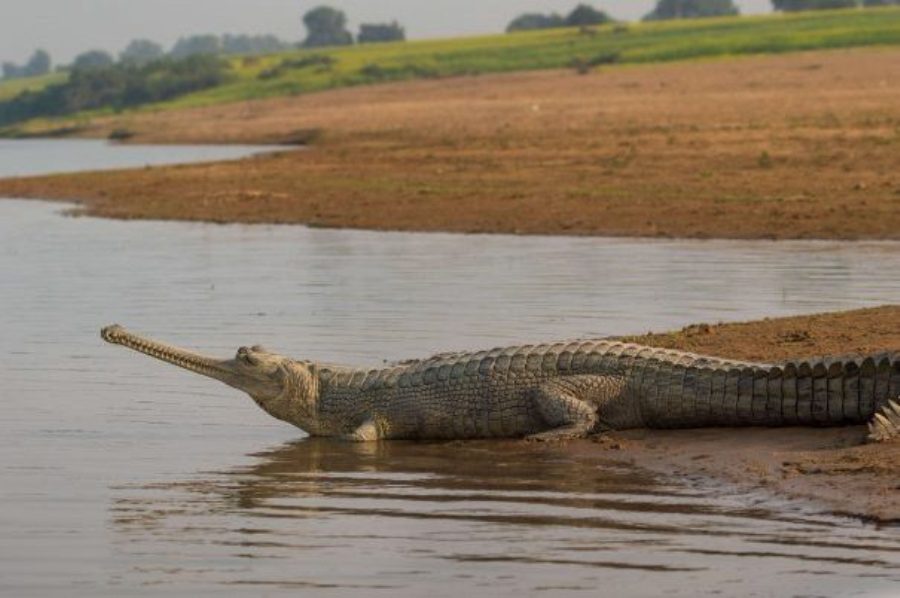
Public sightings often conflate gharials with mugger crocodiles. While muggers are relatively adaptable, gharials are highly specialized fish-eaters with narrow snouts and low tolerance for habitat change.
Importantly, higher numbers do not equal long-term security. Gharials remain vulnerable to pollution, net entanglement, altered river flows and loss of sandbanks — risks that intensify when river governance weakens.
Organizations Supporting Gharial Conservation
Key institutions involved in gharial protection include:
- Ministry of Environment, Forest and Climate Change – Nodal authority overseeing Project Crocodile, national wildlife policy and protected areas
- State Forest Departments of Rajasthan, Madhya Pradesh and Uttar Pradesh – Implement on-ground protection, censuses and nesting management.
- Wildlife Institute of India – Scientific research, monitoring frameworks and policy inputs
- Wildlife Trust of India – Habitat protection, recovery programmes and community engagement
- Society for Conservation of Nature (SCON) – Long-term local monitoring and awareness in the Chambal region
- International Union for Conservation of Nature – Global species assessment and scientific guidance
Corporate & Philanthropic Models Supporting Freshwater Species
The Chambal also offers replicable models for CSR and philanthropic engagement in freshwater conservation.
|
Organisation |
Initiative & Relevance |
|
Tata Chemicals Limited (TCL) |
Through the Tata Chemicals Society for Rural Development, the company’s Dharti Ko Arpan programme demonstrates how long-term corporate partnerships with conservation NGOs can support species recovery. |
|
Wildlife Trust of India (WTI) |
Implements multiple gharial projects, including the Gandak Gharial Recovery Project, where numbers rose from 15 in 2010 to over 250. Actively seeks CSR support for hatchling protection and community “Gharial Guard Groups”. |
|
Wildlife Conservation Trust (WCT) |
Works extensively in the Chambal through the Makara Programme, focusing on gharials and dolphins. CSR funds support research equipment, patrol boats and community training. |
|
WWF-India |
Active since the 2007 Chambal crisis. Supported the release of 250 captive-reared gharials into the Ganga and led bio-logging projects using satellite tags, creating opportunities for tech-led CSR. |
|
Madras Crocodile Bank Trust (MCBT) |
Global authority on gharials. Runs the Gharial Ecology Project in the Chambal, offering corporate options to sponsor research and village education programmes. |
|
KCT Group Trust (with WCT) |
Supported gharial conservation initiatives in other Indian rivers, offering a reference model for private trusts and corporate philanthropy in freshwater ecosystem recovery. |
|
Turtle Ltd (CSR with Turtle Survival Alliance) |
Supported protection and release of critically endangered freshwater turtle hatchlings in river systems, including the Chambal, in coordination with forest authorities. |
A Clear CSR Takeaway
The Chambal denotification highlights a larger truth: policy alone cannot secure India’s freshwater biodiversity. As regulatory frameworks evolve, corporates have a growing opportunity — and responsibility — to support river conservation through science-based, community-linked and long-term CSR investments.
For companies focused on water security, climate resilience and ESG performance, the Chambal is not just a wildlife story. It is a live case study in how shared responsibility between government, communities and corporates will determine whether decades of conservation gains are protected — or slowly undone.