Budget 2026 and India’s Next Water Imperative: From Infrastructure to Governance
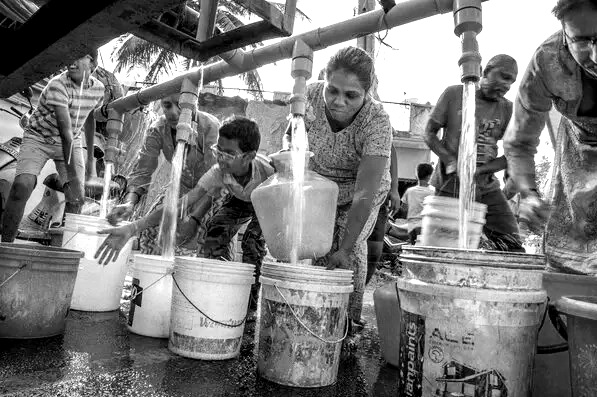
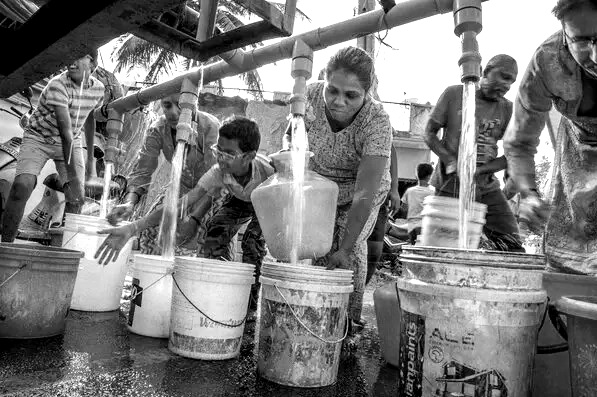
India’s drinking water policy has delivered one of the most visible public infrastructure successes of the past decade. Through sustained fiscal commitment and administrative focus, piped water connections have reached a majority of rural households, transforming everyday life across vast parts of the country. This achievement deserves recognition.
However, as India approaches the Union Budget 2026, the national water conversation must mature beyond access alone. According to the WHO–UNICEF Joint Monitoring Programme, only about three-quarters of India’s population has access to safely managed drinking water, defined as water that is available on premises, free from contamination and accessible when needed. The gap between infrastructure creation and water safety now represents the central challenge for India’s water policy.
 Access Has Improved. Assurance Has Not.
India’s water programmes have historically prioritised expanding physical access. This was necessary and overdue. Yet data from national agencies and global monitoring frameworks point to a widening gap between having a tap and having potable water.
Contamination of drinking water sources by untreated sewage, industrial discharge, agricultural runoff and naturally occurring toxins remains widespread. Groundwater, which supplies a significant share of India’s drinking water, is particularly vulnerable. Multiple districts across states continue to report fluoride, arsenic, iron and nitrate levels exceeding permissible limits.
This challenge is not new, and it is acknowledged in policy frameworks. What remains missing is consistent budgetary prioritisation of quality assurance, treatment capacity and long-term source protection. Water safety is still treated as an add-on rather than as a foundational requirement.
Why Water Quality Surveillance Is the Missing Link
Among the most critical gaps in India’s water governance architecture is the absence of a robust, transparent and continuous water quality surveillance system. Monitoring mechanisms remain fragmented across departments and levels of government, with testing often periodic rather than preventive. Data flows are slow, siloed or inaccessible, weakening early warning and accountability.
Government assessments continue to flag widespread contamination of drinking water sources. Central Ground Water Board data shows that thousands of habitations remain affected by fluoride, arsenic, iron and nitrate contamination, while untreated sewage remains a dominant pollutant in surface water sources supplying urban and peri-urban areas. In the absence of continuous surveillance and public reporting, contamination is often detected only after health impacts begin to surface.
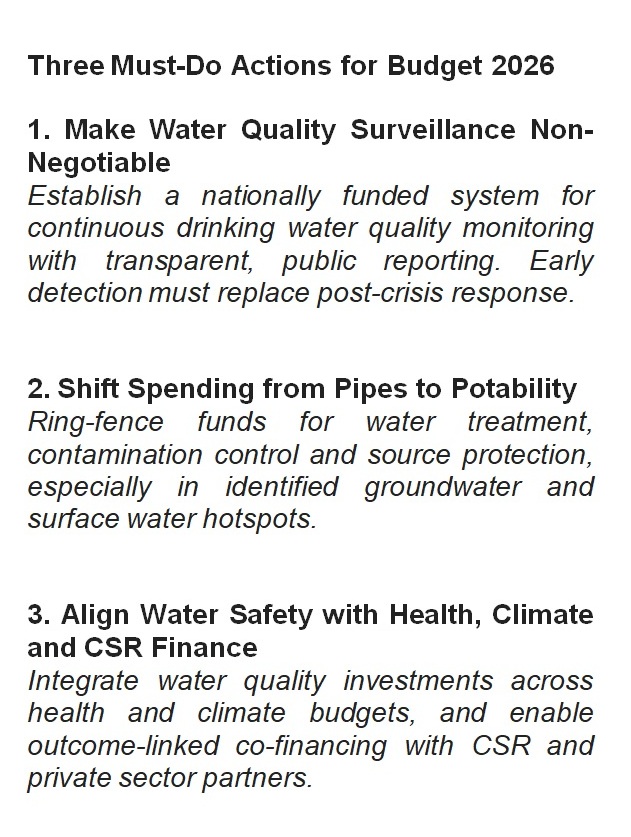
A national water quality surveillance system, supported by budgetary backing, would fundamentally change how water risk is managed. Real-time or high-frequency monitoring, combined with digital reporting platforms, would allow state agencies and local bodies to respond proactively. Public disclosure of water quality data would also strengthen accountability and build trust.
Importantly, surveillance is not merely a technical exercise. It is a governance tool that connects infrastructure, public health and environmental regulation. Budget 2026 must recognise this and move water quality data systems from the margins to the centre of water policy.
The Budget Blind Spot: Water Safety and Public Health
Unsafe drinking water continues to impose a significant health burden, particularly in rural and peri-urban areas. Yet water quality rarely features explicitly in public health budgeting, remaining implicit within broader sanitation or nutrition frameworks rather than being treated as a core preventive intervention.
While allocations for drinking water infrastructure have increased substantially in recent years, spending on water quality monitoring, treatment capacity and source protection continues to form only a small fraction of overall water-sector expenditure. This imbalance limits the ability of states and local bodies to ensure potability once connections are provided and shifts the burden of safety onto households.
Recognising safe drinking water as a preventive health investment would justify closer alignment between water and health budgets. Targeted funding for water quality interventions could reduce avoidable disease burdens while delivering long-term savings to the healthcare system.
Budget 2026 offers an opportunity to formalise these linkages and align water quality investments with national health outcomes.
Climate Stress Is Exposing Structural Weaknesses
Climate variability is amplifying water quality risks across India. Floods overwhelm sewage networks and contaminate surface water sources, while prolonged droughts concentrate pollutants in shrinking aquifers. Despite this, water quality remains largely absent from climate adaptation planning and financing.
Climate budgets often prioritise energy transition and disaster response, while water systems are treated as passive infrastructure rather than climate-sensitive assets. Integrating water quality resilience into climate adaptation funding would allow India to address contamination risks before they escalate into crises.
This integration requires policy intent as much as financial allocation. Without it, climate impacts will continue to erode the gains made under water access programmes.
Collaboration Exists, but Policy Has Not Kept Pace
Across India, corporate social responsibility initiatives, civil society organisations and research institutions are experimenting with water quality solutions. These range from community-level treatment systems and aquifer recharge to digital monitoring tools and source sustainability models.
However, the absence of clear policy frameworks for collaboration limits scale and impact. CSR efforts often operate in isolation from government systems, and successful pilots struggle to transition into mainstream programmes.
Budget 2026 can change this by enabling structured co-financing models, recognising verified water quality outcomes and creating incentives for partnerships that align with national and state water priorities. Collaboration should not be incidental; it should be designed into policy architecture.
A Policy Moment That Should Not Be Missed
India has shown that it can deliver at scale when priorities are clear and funding follows intent. The next leap in water security will not come from more pipes alone, but from better governance of the water flowing through them.
By prioritising water quality surveillance, integrating water safety into health and climate planning and enabling meaningful collaboration across stakeholders, Budget 2026 can signal a decisive shift in India’s water policy trajectory.
The question before policymakers is no longer whether India can provide water to its citizens. It is whether the country is ready to guarantee that this water is safe, reliable and fit for the future.